Sourcing matcha from Japan as a food manufacturer is a different process than buying for a café. The documentation requirements are more demanding, the volume expectations are higher, and the regulatory obligations Eparticularly around FDA FSVP Erequire careful supplier vetting before a first order ships. This guide walks through everything a procurement team needs to know.
Why Japan remains the gold standard for matcha supply
Matcha is specifically a Japanese product Ethe shade-growing, tencha harvesting, and stone-milling process that produces true matcha originated in Japan and remains most concentrated in the prefectures of Kagoshima and Shizuoka. While matcha-style green tea powders are now produced in China and elsewhere, Japanese-origin matcha commands a premium for three reasons that matter to food manufacturers: flavor profile consistency, color stability, and certification infrastructure.
Japanese matcha producers are more likely to hold internationally recognized food safety certifications (BRCGS, FSSC 22000) and to have invested in analytical testing infrastructure that supports the documentation needs of US and European food brands. When a procurement team needs L*a*b* color specs, lot-level pesticide residue data, or FSVP-supporting documentation, Japanese manufacturers are significantly more equipped to provide it than most alternative origins.
Understanding FDA FSVP before you place a first order
The Foreign Supplier Verification Program (FSVP), governed by 21 CFR Part 1 Subpart L, requires US importers of food Eincluding matcha Eto establish and follow written procedures verifying that their foreign suppliers are producing food in a manner that provides the same level of public health protection as the Preventive Controls rules. In practical terms, this means your company needs a documented FSVP file for every foreign ingredient supplier.
When evaluating a Japanese matcha supplier, ask explicitly: “Can you provide documentation to support our FDA FSVP file?” A qualified manufacturer will supply their current food safety certification (including scope and expiry date), a recent third-party audit summary, and their Hazard Analysis document. If a supplier cannot produce these on request, they are not appropriate for a food manufacturer's supply chain.
Yuminaga’s facilities hold both BRCGS Grade A and FSSC 22000 certifications and routinely provide full FSVP-supporting documentation to US importers as part of onboarding.
What certifications to require from a matcha supplier
Not all certifications are equal, and not all of them are relevant for food manufacturing procurement. Here is what actually matters:
| Certification | What it confirms | Who requires it |
|---|---|---|
| BRCGS Grade A | Highest tier food safety management Etraceability, HACCP, allergen control, facility audits | US retailers, co-packers, major food brands |
| FSSC 22000 | ISO 22000-based food safety system Erisk management, supplier controls | Multinational food manufacturers, supplement brands |
| Organic (JAS / USDA NOP) | Certified organic farming and processing Eno synthetic pesticides | Natural food brands, supplement companies |
| Non-GMO | No genetically modified ingredients in product or processing | US natural channel, EU markets |
Require the actual certification document Enot a logo on a sell sheet. Certificates should include the certification body name, scope of certification, facility address, issue date, and expiry date. Verify the certificate directly with the issuing body if the relationship is significant.
COA requirements for food manufacturing matcha
A Certificate of Analysis (COA) is the batch-level document that proves a specific lot of matcha met specification before it shipped. For food manufacturing, a COA should be lot-specific Etied to the exact batch you receive Enot a generic annual document.
A complete matcha COA for food manufacturing use should include:
- Moisture content (%)
- Ash content (%)
- Particle size distribution (D50, D90 values in microns)
- Color specification (L*, a*, b* CIE values)
- Total aerobic plate count (cfu/g)
- Yeast and mold count (cfu/g)
- Coliforms / E. coli
- Heavy metals: lead, cadmium, arsenic, mercury (ppm)
- Pesticide residue panel (EU MRL or CODEX standard)
- Lot number and production date
If your supplier’s COA is missing heavy metal or pesticide data, request it separately. These tests are non-negotiable for any ingredient entering a finished food product sold in the US.
Evaluating supply chain reliability and scaling capacity
For food manufacturers, the ability to scale is as important as the quality of the initial sample. A supplier who can deliver 10kg of excellent matcha but cannot reliably supply 500kg per month for a production run is not viable for an ongoing manufacturing relationship.
Key questions to ask about capacity and reliability:
- How many metric tons of matcha do you produce or process annually?
- Do you have multiple supply sources or production facilities to buffer seasonal variation?
- Can you hold safety stock or offer forward supply agreements?
- What is your typical lead time for a repeating production run vs. a first order?
- What happened to your supply during the 2023–2026 matcha shortage period?
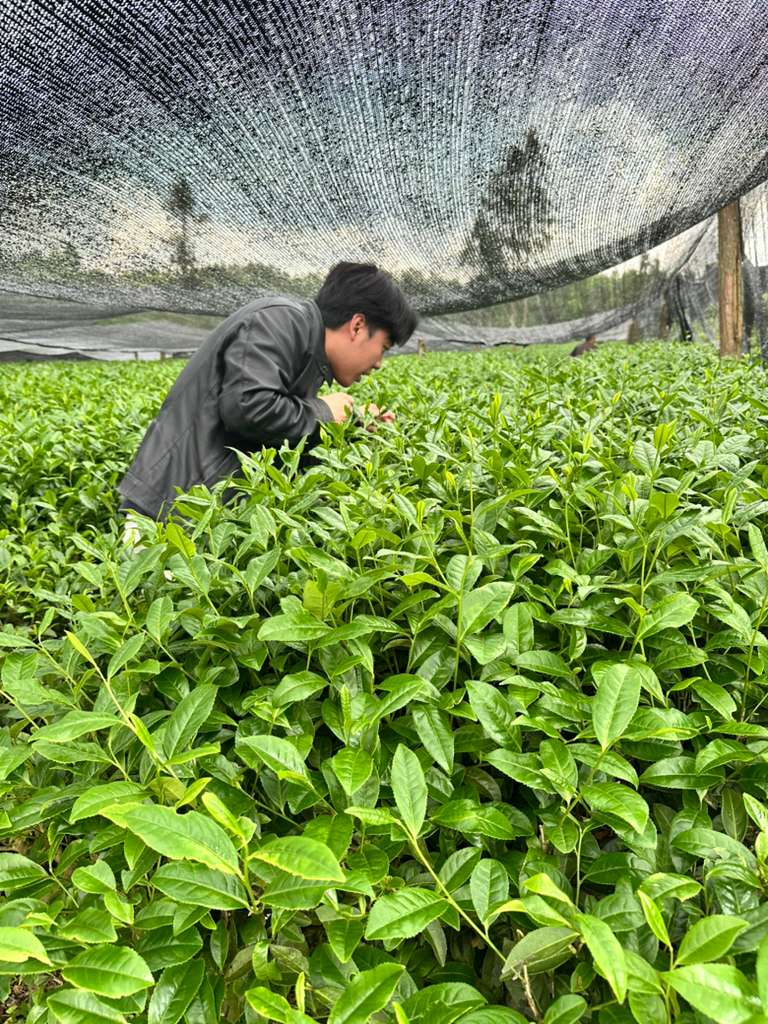
Yuminaga operates integrated facilities in Japan, China, and Vietnam, providing multi-origin supply resilience. For buyers with regular production runs, we offer forward supply contracts that lock in volume and pricing across a 6–12 month horizon.
Requesting samples: what to test and how
Sample evaluation for food manufacturing is more rigorous than for café use. You are evaluating not just flavor and color, but processing behavior Ehow the matcha performs in your specific production environment.
Test your matcha samples for:
- Cold dispersion: Does it disperse evenly in cold liquid without clumping? Critical for RTD beverage lines.
- Heat stability: Does color hold after pasteurization or UHT treatment? Request color data before and after your process.
- Bitterness at scale: Flavor in a test kitchen often differs from flavor at production batch concentration.
- Blend compatibility: Test in your exact formulation Ewith other powders, emulsifiers, or sweeteners if applicable.
Request samples from at least two grades and compare side by side in your production environment before committing to a supply relationship. See our matcha grades guide for food manufacturers for a detailed grade comparison.
Typical lead times and logistics for Japan imports
Understanding realistic lead times prevents production schedule surprises. From Japan:
- Air freight: 3–5 business days door-to-door, significantly higher freight cost
- Sea freight (LCL): 4–6 weeks, cost-efficient for regular production volume
- Sea freight (FCL): 3–5 weeks for full container loads
Build your safety stock around your sea freight lead time Enot air freight. Air freight is a contingency option, not a sustainable supply model at food manufacturing volumes. Most manufacturers carry 6–8 weeks of matcha inventory to absorb transit variation and Japanese public holidays (Golden Week in May affects shipping schedules significantly).